
Pablo Picasso did not merely participate in the 20th-century art world; he aggressively dismantled and rebuilt it several times over. His greatest contribution was not a single masterpiece, but a lifelong commitment to restless reinvention that challenged the very definition of what art could represent.
While most artists spend a lifetime perfecting a signature style, Picasso treated success as a signal to move on. From the monochromatic despair of his youth to the fragmented geometry of Cubism, his career serves as a map for the evolution of modern consciousness. To understand Picasso is to understand the shift from art as an imitation of life to art as an autonomous, intellectual construction of reality.
Why did Picasso turn to blue?
Picasso’s Blue Period (1901–1904) was born from the suicide of his friend Carles Casagemas. For three years, his palette remained almost exclusively monochromatic, using shades of blue to convey isolation and social despair. Research Starters notes this was a definitive break from academic realism, shifting toward raw, emotional expressionism.
During this time, Picasso lived in poverty, painting society’s outcasts—beggars, drunks, and the infirm. Works like The Old Guitarist utilized elongated limbs to emphasize hopelessness, an influence drawn from the Spanish master El Greco. While commercially unsuccessful then, this era proved that art's truth lay in internal struggle rather than external appearance.
How did romance shift Picasso's palette?
Romance triggered the transition to the Rose Period (1904–1906), as Picasso’s relationship with Fernande Olivier shifted his palette to warm earth tones and pinks. Scribd's art timeline indicates this shift moved his focus from the destitute to more whimsical subjects, specifically circus performers and harlequins.
He found kinship with saltimbanques—itinerant performers who lived on the margins but brought spectacle to the public. These figures are more volumetric than the skeletal Blue Period subjects, signaling a renewed interest in form. This movement toward abstract characterization served as a bridge to his later, more radical stylistic explosions.
What sparked the break from traditional form?
The most radical turning point in modern art history occurred in 1907, when Picasso visited the Trocadéro Museum of Ethnology in Paris and encountered African and Oceanic masks. This encounter fundamentally changed his understanding of what art could be, shifting his focus from the imitation of nature to the expression of "magic" and spiritual power. Research Starters states that this "African Period" (1907–1909) allowed Picasso to finally abandon the traditional laws of proportion and harmony that had governed Western art since the Renaissance.
The culmination of this influence was Les Demoiselles d’Avignon (1907), a painting so controversial that even Picasso’s closest friends initially reacted with horror. The canvas depicts five nude women whose bodies are rendered as a jarring assemblage of disorderly facets and triangular wedges. Two of the figures wear hideous, mask-like faces that reflect the influence of African sculpture, while their anatomy is distorted into impossible geometric shapes.
By shattering the single-point perspective that had dominated art for 500 years, Picasso created the first truly modern painting. Les Demoiselles d’Avignon was not meant to be "beautiful" in the traditional sense; it was an intellectual and visceral attack on the status quo. Picasso sought to depict power and spirit rather than mere reality. This period proved that an object did not need to look like its physical counterpart to be "true," a realization that provided the conceptual foundation for the development of Cubism. This era of "proto-cubism" was a declaration of independence from the eyes, moving the artistic process firmly into the mind.
How did Cubism dismantle the visual world?
Cubism was not just a style; it was a revolution in how humanity perceives the physical world. Developing between 1907 and 1914 in close collaboration with Georges Braque, the movement sought to represent objects from multiple viewpoints simultaneously. Instead of looking at a subject from a single, fixed position, a Cubist painting presents a synthesis of different perspectives layered onto a flat surface. According to Saatchi Art, this technique allowed Picasso to render three-dimensional objects in a conceptual, rather than literal, way.
The movement is generally divided into two distinct phases:
Analytical Cubism (1909–1912): In this phase, Picasso and Braque "analyzed" forms by breaking them down into a series of flat, tonal planes. The color palette was severely restricted to muted browns, grays, and blacks to ensure that the focus remained on the geometric structure rather than decorative appeal.
Synthetic Cubism (1912–1919): This phase emphasized the "synthesis" or bringing together of different media. Picasso effectively introduced collage to the fine art world, incorporating everyday materials like newspaper clippings, rope, and wallpaper into his canvases.
By introducing collage, Picasso blurred the lines between "high art" and common objects, a move that would influence everything from Dada to Pop Art. Cubism challenged the viewer to become an active participant in the creation of the image, requiring the eye to reassemble the fragmented parts into a cohesive whole. It was an intellectual exercise that mirrored the complexities of the modern industrial age, suggesting that reality is never a single, static image, but a series of overlapping experiences and perceptions. This period remains the most influential of Picasso's career, as it provided the visual language for much of the abstraction that would follow in the 20th century.
When does art become a political tool?
While Picasso never officially joined the Surrealist movement, his work from the mid-1920s to the 1930s was deeply informed by its focus on the unconscious and the irrational. He moved away from the strict geometry of Cubism toward more organic, often distorted and violent, forms. This era reached its peak with the 1937 masterpiece Guernica, a painting that transformed his artistic innovations into a profound political statement against the horrors of war.
Commissioned for the Spanish Pavilion at the Paris World's Fair, Guernica was a response to the Nazi bombing of the Basque town of Guernica during the Spanish Civil War. Picasso utilized a monochromatic palette of gray, black, and white to evoke the immediacy of newspaper photography and the starkness of tragedy. The painting is filled with symbolic imagery—a screaming horse, a fallen soldier, and a mother clutching a dead child—all rendered in a style that fused Cubist fragmentation with Surrealist emotional intensity.
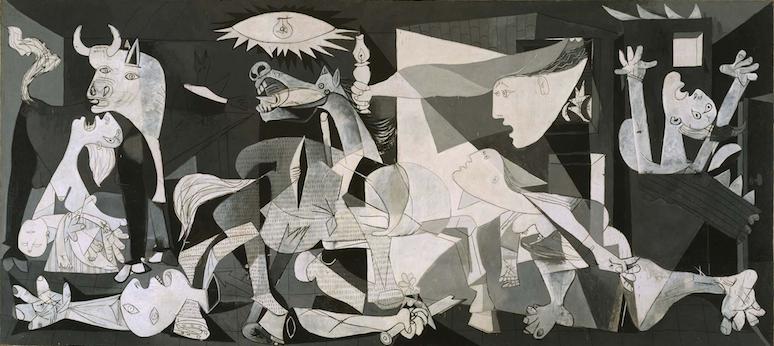
Guernica proved that modern art could be more than a formal experiment; it could be a powerful means of social protest and historical record. It remains perhaps the most famous anti-war artwork in history, capturing the universal suffering of civilians in the face of modern warfare. For Picasso, this marked a shift from personal exploration to a engagement with the turbulent socio-political landscape of his time, proving that the radical forms he had spent decades developing were uniquely suited to express the fractured reality of the 20th century. Through Guernica, Picasso's restlessness found its most enduring and impactful purpose.
The legacy of a restless reinventor
Picasso’s legacy is not found in a single style, but in the permission he gave to future generations to constantly change. He broke the monopoly of the realistic image, proving that art's value lies in its ability to provoke thought and emotion rather than simply document the world. His influence is visible in nearly every movement that followed, from Abstract Expressionism to contemporary digital art.
Beyond canvas and paper, he extended his restless energy into ceramics, sculpture, and even theatre design. He famously collaborated on the ballet Parade, bringing the avant-garde to the stage. Over the course of his lifetime, he is estimated to have produced more than 20,000 artworks, a figure that underscores his status as the most prolific artist of the modern era.
By refusing to stand still, Picasso became the ultimate symbol of the modern artist: one who understands that to stay relevant, one must be willing to destroy their own success in order to build something new. He remains a cornerstone of the 20th century, a figure whose metamorphosis of genius continues to challenge how we see, think, and create.
1Did Picasso invent Cubism alone?
No, he co-founded the movement with Georges Braque. Their collaboration was so close between 1909 and 1912 that some of their works from that period are nearly indistinguishable.
2How many artworks did Picasso produce in his lifetime?
Experts estimate that Picasso created more than 50,000 pieces of work, including approximately 1,885 paintings, 1,228 sculptures, and nearly 3,000 ceramics.
3Why is 'Les Demoiselles d'Avignon' considered the first modern painting?
It is considered revolutionary because it rejected the single-point perspective used since the Renaissance, depicting objects from multiple viewpoints and incorporating non-Western influences like African masks.


No comments yet. Be the first to share your thoughts!